
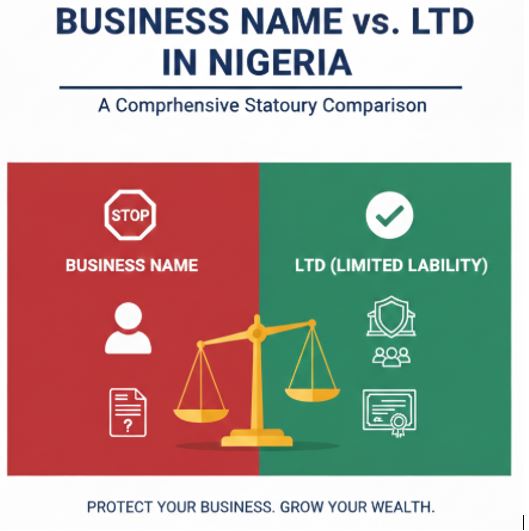
This is the most common legal question Nigerian business founders ask: “Should I register a Business Name or a Limited Liability Company (LTD)?” The right answer can save you from lawsuits, tax trouble, and growth limitations later. This guide breaks it down clearly, legally, and practically so you can choose based on liability, cost, credibility, and long-term vision.
In the Nigerian economy today, choosing between a Business Name and a Private Limited Company (LTD) is no longer just a matter of “finding a name.” It is a strategic decision that determines how much of your personal life you are willing to bet on your business success.
Are you simply looking for a clean way to track your freelance income, or are you building a brand that will one day hire 50 people and bid for multi-million-naira contracts?
Many founders rush into a Business Name registration because it is cheaper at the beginning, only to discover a few years later that they cannot take a bank loan, bring in a partner, or attract an investor without a messy and expensive conversion process.
This article is part of our ultimate guide to registering and Starting a Business in Nigeria. While the main guide shows you the full journey from idea to expansion, this page focuses on one of the most important decisions you will ever make: choosing the right legal structure for your business.
Before we talk about fees or taxes, we have to talk about safety. In a volatile market, your business structure isn’t just a label—it is your insurance policy. The real decision isn’t about which form is easier to fill out; it’s about where you draw the line between your business’s debts and your family’s assets.
This decision is not about forms, speed, or convenience as I said. It is about risk and protection. That brings us to the most important question every founder must answer:
“What am I really choosing between?”
Not just a Business Name versus an LTD, but your personal exposure versus corporate protection.
This brings us to the most critical divide in Nigerian law: — The Core Difference: Personal Risk vs. Corporate Protection
Core Difference: Personal Risk vs. Corporate Protection
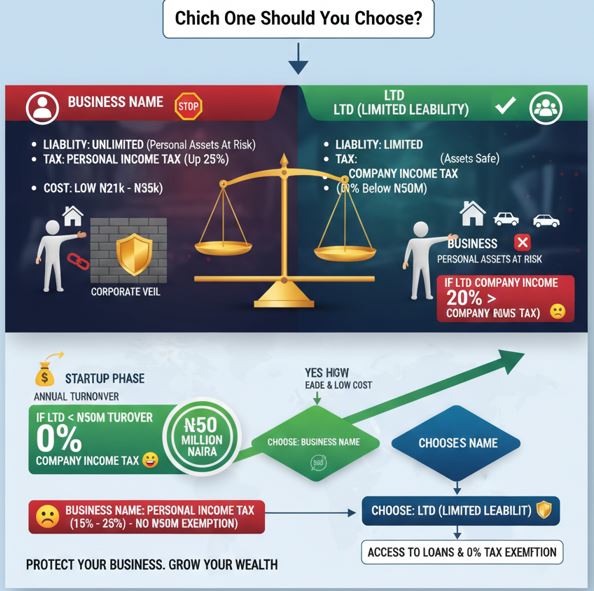
In the eyes of the Nigerian legal system, the structure you choose determines whether there is a “Wall of Protection” between your family’s life and your business’s failures.
The Business Name (Unlimited Liability)
When you register a Business Name (Enterprise), you are not creating a new person. You are simply giving yourself a “nickname” to trade with.
- The Legal Reality: You and the business are one and the same. There is no legal “skin” between your business bank account and your personal savings.
- The Risk: If your business is sued for ₦5 million, but the business only has ₦1 million in its account, the court doesn’t stop there. Creditors can legally “reach through” the business name and seize your personal car, your family land, or the money in your personal savings account.
- Status: This is “Unlimited Liability.” Your risk is as big as your biggest mistake.
The Private Limited Company (LTD)
An LTD is a Separate Legal Entity. The moment you receive that certificate, a “New Person” is born—one that can own property, sign contracts, and be sued independently of you.
- The Legal Reality: The Company is a “Corporate Shield.” It stands between you and the world.
- The Protection: If the company fails or is sued, the law only looks at what the company Your personal house, your spouse’s joint account, and your personal investments are legally “off-limits” to the company’s creditors.
- Status: This is “Limited Liability.” Your risk is limited strictly to the amount you invested in the company’s shares.
Why 2026 is Different: The “Corporate Veil”
Currently, Nigerian courts are stricter than ever regarding debt recovery. With a Business Name, a “Judgment Debt” follows you for life—even if you close the business. With an LTD, if the business goes bankrupt, you can legally walk away with your personal wealth intact (provided there was no fraud).
Important Note: This protection is called the “Corporate Veil.” It only works if you keep your finances separate. If you use your business account to pay your children’s school fees, a court can “pierce the veil” and hold you personally liable anyway.
Protecting your assets is the defensive move. Now, let’s look at the offensive side: Money.
While the LTD offers the best safety, does it cost too much to maintain? How do the two structures compare when it’s time to pay taxes to the FIRS or ask for a loan at the bank?
Next, we break down the numbers: The Head-to-Head Comparison: Costs, Taxes, and Credibility
Cost, Tax, and Growth Reality: Business Name vs. LTD
While the “wall of protection” is the emotional reason to choose an LTD, the financial and growth realities are where the decision becomes undeniable. In Nigeria today, the tax system, banking system, and funding ecosystem are all quietly structured to favor properly incorporated companies over informal enterprises.
Head-to-Head Comparison: Business Name vs LTD
| Feature | Business Name (Enterprise) | Private Limited Company (LTD) |
| Initial Setup Cost | ₦10,500 – ₦15,000 | ₦25,000 – ₦50,000+ (includes Stamp Duty) |
| Annual Maintenance | ₦5,000 (Annual Returns) | ₦5,000 – ₦15,000+ (scales with capital) |
| Corporate Income Tax (CIT) | Not applicable | 0% (For “Small Companies” < ₦50M turnover) |
| Personal Tax Exposure | 7% – 25% on all profit (PIT) | Only on the Salary or Dividends you withdraw |
| Bankability | Low (mostly micro-loans) | High (BOI, commercial banks, development funds) |
| Investment Appeal | None (cannot sell shares) | High (VC, angels, equity funding possible) |
- The Tax Reality: Why Small Companies Quietly Win
Under Nigeria’s current tax framework (NTA 2025), small companies enjoy the most generous incentives in the system.
- LTD Advantage: If your annual turnover is ₦50 million or less, your Company Income Tax is 0%. You are also exempt from the 4% Development Levy that larger firms must pay. Essentially, you can reinvest every kobo of profit back into the business.
- Business Name Trap: Because a Business Name is legally you, all profits are taxed as personal income. Since the first ₦800,000 is tax-free, anything above that is taxed on a progressive scale up to 25%. As your business grows, your tax bill grows with it, even when a similar LTD would still be paying little or nothing.
- The Math: Two businesses make ₦20 million profit. The Business Name pays nearly ₦3.6 million in personal income tax. The LTD (if it keeps the money in the company) pays ₦0 in corporate tax.
- Growth and Funding: Why Banks Prefer “Ltd”
Banks do not fund ideas; they fund structures.
- For an LTD: Banks see a Memorandum and Articles of Association (MEMART), a share structure, and a board of directors as signs of permanence. This makes you eligible for Bank of Industry (BOI) long-term loans and commercial SME facilities with lower interest rates.
- For a Business Name: Most lenders see an Enterprise as a “one-man risk.” If the owner disappears, the business dies. Funding is usually limited to short-term, high-interest micro-loans from fintechs or microfinance banks.
- The Hidden Cost of “I’ll Convert Later”
Many founders think they are saving money by starting small. In reality, “upgrading” later is a logistical nightmare. In Nigeria, conversion usually means:
- Closing the Business Name (Cessation of Business filing).
- Registering a brand-new LTD and paying fresh Stamp Duties.
- Updating your TIN and re-validating with the FIRS.
- Changing bank accounts and re-signing every single client contract.
Best Strategic Approach: Starting as an LTD from Day 1 is usually 3x cheaper than registering a Business Name today and converting it in two years.
Final Verdict
Choose a Business Name if:
- You are a freelancer or solo artisan. You want to protect your personal house and car.
- You want the simplest, cheapest setup.
- You want 0% tax exposure on your first ₦50M.
- You do not plan to raise funding or scale.
- You are testing a side-hustle.
Choose an LTD if:
- You want asset protection
- You want lower long-term tax exposure
- You want access to serious funding
- You want access to BOI and commercial loans.
- You are building a legacy brand.
This is not just a registration choice. This is the foundation of your business future.
Frequently Asked Questions (FAQ)
Q1: Can I start with a Business Name and later upgrade to an LTD?
A: Yes. The process involves applying for “Consent” from the CAC to use the same name, ensuring your Annual Returns are up to date, and then registering the name as a Limited Company. It is a common path for POS agents who want to start small and scale later.
Q2: Which one is better for getting a loan? e.g. POS loan
A: LTD is superior. While some fintechs give small loans to Business Names, traditional banks and government intervention funds (like BOI or NEPC) usually require an LTD structure because it signals a more formal and stable business.
Q5: What happens to my debt if my POS business fails?
A: Business Name: You are personally liable. Creditors can seize your personal properties (car, house, phones) to pay back the debt.
LTD: Your liability is “limited” to the money invested in the company. Your personal assets are legally protected from business creditors.
Q3: Do I pay more tax as an LTD?
A: Not necessarily. In fact, under current Nigerian tax laws, Small Companies (LTDs) with an annual turnover below ₦50 Million are exempt from Company Income Tax (CIT). A Business Name, however, is taxed as Personal Income, which has no such “zero tax” turnover threshold.
Q4: Can I register an LTD alone, or do I need a partner?
A: Under the current CAMA (2020) rules, a single person can register and own a Private Limited Company in Nigeria. You no longer need to look for a second director or shareholder just to get registered.
Conclusion
While a Business Name is an extension of the individual (unlimited liability), an LTD is a distinct legal entity. Choosing between them depends on your growth stage: a Business Name offers simplicity for solo operators, whereas an LTD provides a “corporate veil” that protects personal assets and opens doors to institutional funding and tax exemptions for small companies.
Free Business Launch Toolkit (latest Edition)
Ready to launch your new company, we have released the best Nigeria-Specific Business Plan & Feasibility Toolkit. It includes ready to use business plan for bank loans and an automated “Float Manager” spreadsheet to help you track daily profits and commission margins accurately